Why Your $300 Phone Now Has a Better Battery Than a $1,000 Phone From 3 Years Ago
You plug in your phone at night. You wake up. It is still at 100%. You go through a full school day, two hours of YouTube, a gaming session, and a walk with GPS on. You come home at 8 PM. Your battery shows 41%.
That is not magic. That is the mid-range battery boom and it is quietly changing everything about how we use phones.
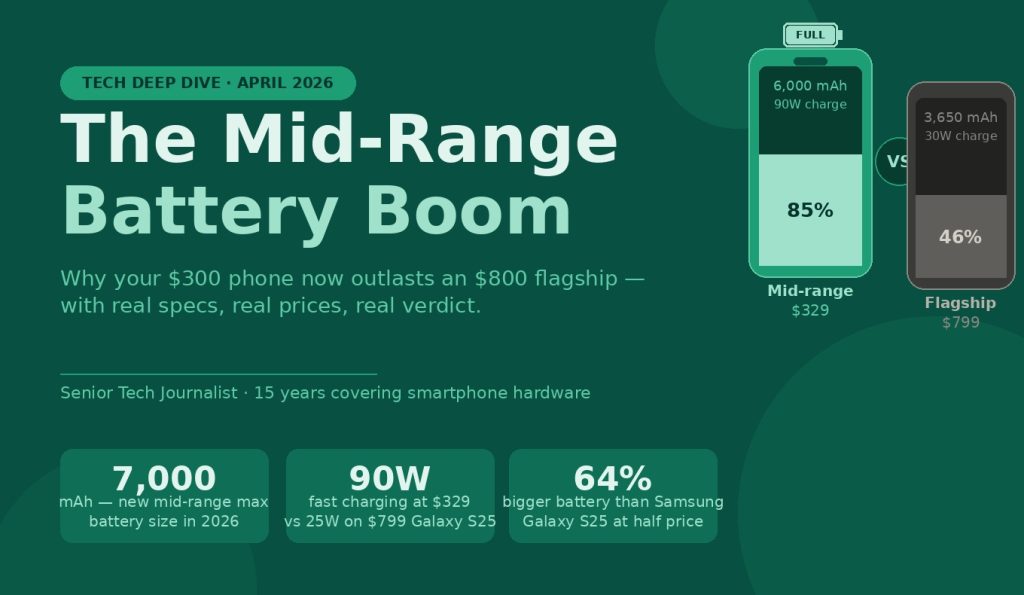
What Is the Mid-Range Battery Boom and Why Is It Happening Right Now?
A “mid-range phone” is a phone that costs between $200 and $500. Think of it like the family car. It is not a Ferrari. But in 2024 and 2025, the family car started getting a jet engine.
We are talking 6,000 mAh to 7,000 mAh batteries. For comparison, think of your phone battery like a water bottle. Three years ago, mid-range phones had a medium bottle (4,000 mAh). Now they have a giant jug (6,000–7,000 mAh).
Why did this happen?
- Battery cells got cheaper. The cost of lithium cells dropped by about 40% between 2022 and 2024.
- Chips got smarter. New processors use less power to do the same work.
- Competition got fierce. Brands need a “wow factor” that is easy for buyers to understand. A big battery number sells phones.
Chinese brands led the way. Xiaomi and Realme proved big batteries could fit in thin phones. Others had to follow.
How Do Mid-Range Phone Batteries in 2026 Compare to Flagship Phones?
This is the part that surprises most people. Let’s look at real phones with real prices as of April 2026.
Is a Bigger mAh Battery Always Better?
Here is a common question. The short answer is: mostly yes, but not always.
Think of battery life like a car trip. The battery is the gas tank. The processor is the engine. A big tank helps. But a thirsty engine eats it fast.
What makes a battery last long:
- Battery size (mAh): Bigger is better, all else being equal.
- Processor efficiency: The Snapdragon 7s Gen 3 (used in many 2025 mid-range phones) uses far less power than older chips.
- Screen resolution and refresh rate: A 120Hz, 1080p screen uses less power than a 120Hz, 1440p screen.
- Software optimization: Good software tells the phone to “go to sleep” on the parts it is not using.
What mAh alone does NOT tell you:
- How smart the software manages power
- How hot the phone gets (heat kills battery life)
- How the battery ages over time
- A phone with 7,000 mAh and bad software can lose to a 5,000 mAh phone with great software.
How Fast Charging Has Changed the Battery Game for Budget Phones
Fast charging used to be a luxury. Now it is a mid-range standard and in some cases, mid-range phones charge faster than flagships.
A simple way to understand charging speed:
Imagine filling that giant water jug with a hose. A slow charger is like a thin straw. A fast charger is like a fire hose. The Xiaomi Redmi Note 14 Pro+ uses a 90W charger. That fills a 6,000 mAh battery in about 45 minutes. The Samsung Galaxy S25 Ultra uses 45W and takes about 70 minutes to charge its 5,000 mAh battery.
Key fast charging speeds in mid-range phones (April 2026):
- 18W–25W → Slow. Seen in older budget phones. Takes 2+ hours.
- 33W–45W → Good. Common in Samsung mid-range. About 60–80 minutes.
- 65W–90W → Excellent. Common in Xiaomi and Realme. About 40–55 minutes.
- 100W+ → Very fast. Some Chinese flagships only. Under 30 minutes.
Wireless charging is still mostly a flagship feature. Most mid-range phones under $400 skip it. But some exceptions exist — the Samsung Galaxy A56 now supports 15W wireless charging in some markets.
Expert Analysis: The Real Winner Nobody Is Talking About
Here is an opinion you will not find on the first page of Google results.
The mid-range battery boom has quietly exposed a premium phone pricing problem.
Apple and Samsung charge $800–$1,200 for their best phones. A big part of their pitch is “it just works” and “it lasts all day.” But in 2026, a $329 Xiaomi Redmi Note 14 Pro+ also lasts all day. It lasts longer, in fact.
Flagship phones are losing one of their strongest selling points — battery life — and most reviewers are not saying it loudly enough.
Where flagship phones still win:
- Camera systems (especially low-light and zoom)
- Software updates (Apple gives 5–7 years; many mid-range phones give 2–3)
- Build quality (premium glass and metal vs. plastic backs)
- Brand status and resale value
Where mid-range phones now win:
- Battery capacity (often 30–60% bigger)
- Charging speed (often 2x faster)
- Raw battery life in daily use
- Price-to-battery-size ratio
Our Verdict: If your main phone complaint is “it dies before 9 PM,” a $299–$349 mid-range phone in 2026 will solve your problem better than a $799 flagship. The only reasons to go flagship are cameras, software longevity, and personal preference. Battery life is no longer one of those reasons.
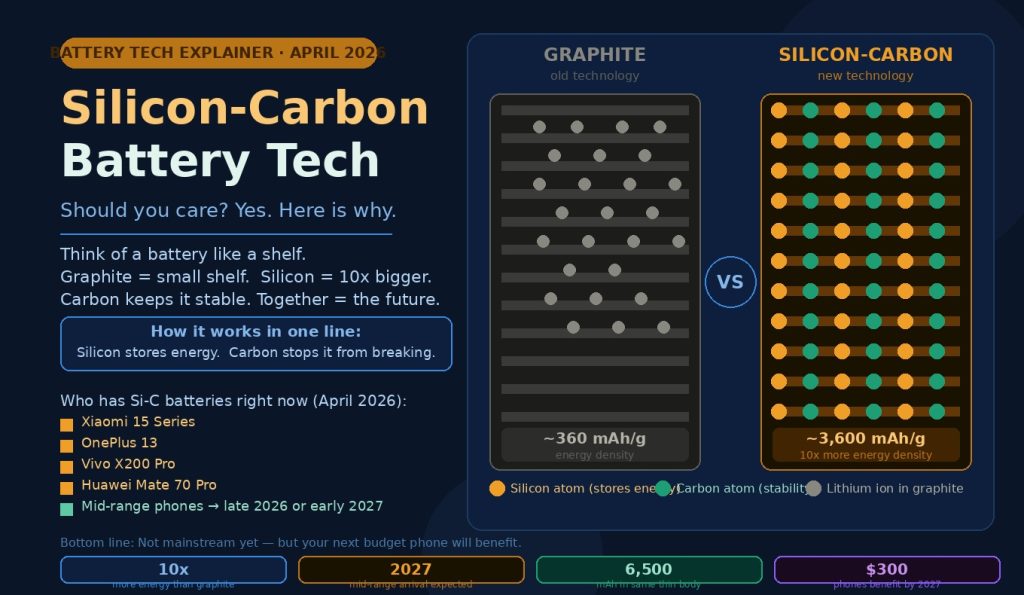
What Is Silicon-Carbon Battery Technology and Should You Care?
You may have seen the words “silicon-carbon battery” or “Si-C battery” pop up in phone reviews. This sounds very technical. But here is a simple way to think about it:
Regular batteries use graphite to store energy. Graphite is like a small shelf. It can only hold so much. Silicon holds about 10 times more energy than graphite. So if you replace graphite with silicon, you can store far more energy in the same space.
The problem: Silicon expands and shrinks as it charges and drains. Think of a sponge. If you soak it too many times, it breaks. Battery makers solved this by mixing silicon with carbon (a more stable material) to make a stronger, more flexible “shelf.”
Who has silicon-carbon batteries right now (April 2026):
- Xiaomi 15 Series (flagship, but technology is coming to mid-range)
- Huawei Mate 70 Series
- OnePlus 13
- Vivo X200 Pro
When will they come to mid-range phones? Most analysts expect silicon-carbon batteries to become standard in $250–$400 phones by late 2026 or early 2027. When that happens, a $300 phone could carry a 6,500 mAh battery in the same thin body as today’s 5,000 mAh phones.
How Long Do Mid-Range Phone Batteries Last Before They Start to Degrade?
Battery health is like a rechargeable AA battery. It works great at first. Over time, it holds less charge. The question is: how fast?
Phone batteries are rated in charge cycles. One cycle = one full charge from 0% to 100%. Most phone batteries are rated for 500 charge cycles before reaching 80% capacity.
What 80% capacity means in real life:
If your phone started with a 6,000 mAh battery, after 500 cycles (roughly 1.5 to 2 years of daily charging), it might hold about 4,800 mAh. That is still a decent battery for most people.
Tips to make your mid-range battery last longer:
- Do not charge to 100% every single day. Stop at 80%–90%.
- Do not let it drop to 0%. Keep it above 20% when possible.
- Avoid charging with very hot chargers in very hot rooms. Heat is the enemy.
Many phones in 2026 now have “smart charging” modes that slow down charging to protect the battery. Turn these on.
Frequently Asked Questions:
Q: Is a 6,000 mAh battery good enough for two days of use?
For light users yes. If you mostly text, browse, and take occasional photos, a 6,000 mAh phone like the Xiaomi Redmi Note 14 Pro+ can reach 2 days. Heavy users (gaming, video streaming, GPS) will still need to charge daily.
Q: Does fast charging damage the battery faster?
Slightly. Very fast charging (90W+) does produce more heat, which speeds up wear. However, most brands in 2026 have thermal management systems that limit damage. The practical difference in battery lifespan between 45W and 90W charging is small for most users.
Q: Which mid-range phone has the best battery life in April 2026?
Based on current data, the Xiaomi Redmi Note 14 Pro+ (6,000 mAh, 90W charging, ~$329) and Realme 14 Pro+ (6,000 mAh, 80W, ~$319) lead the segment. Both offer 17–20 hours of screen-on time in real-world tests.
Q: Should I buy a mid-range phone just for battery life?
If battery life is your biggest problem, yes. But check the camera and software update policy too. Some brands offer only 2 years of updates. If you keep phones for 4–5 years, a longer update commitment matters.
Q: Are wireless charging and reverse wireless charging available on mid-range phones?
Rarely below $400. Most mid-range phones offer wired fast charging only. Wireless charging is still mostly a feature found in $500+ phones. The Samsung Galaxy A56 is a notable exception with 15W wireless charging at $349.