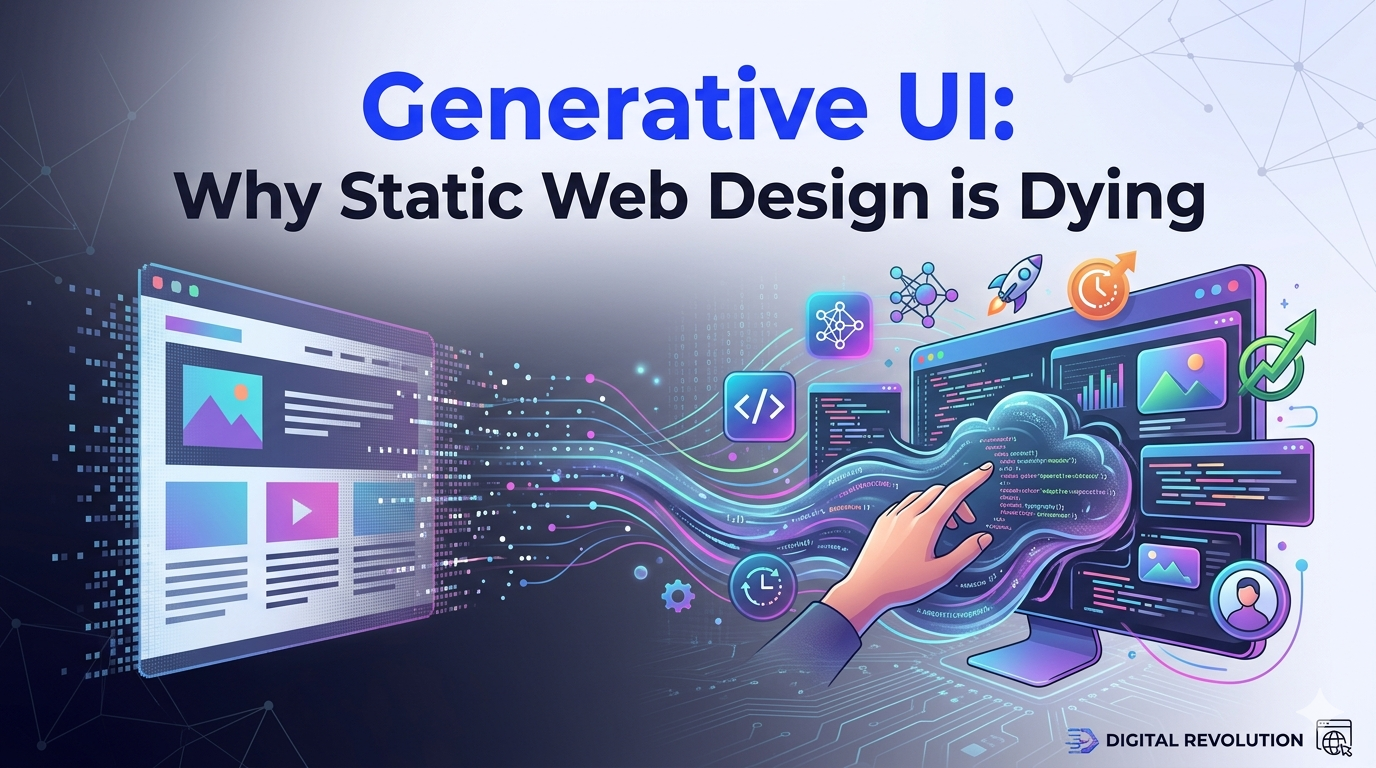
The web design and design in general has been an exercise of trial and error during most of the last three decades, but with the advent of generative UI static web design, we’re seeing a significant shift. And we’ve seen designers work weeks researching user personas, perfecting pixel-perfect Figma layouts, and writing responsive breakpoints by hand to release one static experience that they thought would work on everyone. But it was what we referred to as responsive design – though, in actuality, it was merely a bunch of hard-coded templates that were stretched and squashed accordingly to fit into various sizes. So, the web site essentially appeared the same whether a power user was after deep analytics or the very first visitor, searching for the price, which is where generative UI static web design comes in to provide a more personalized experience. And I don’t think we’ve ever had a more exciting time in web design, as generative UI static web design is changing the game. But, it’s not without its challenges, and we’ll need to balance the benefits of generative UI static web design with the potential drawbacks. And, as I’ve seen firsthand, the impact of generative UI static web design can be significant, with many companies already experiencing improved user engagement and conversion rates.
Then came 2026, and the grid at last broke. Gone are the days of non-portable wrappers. In today’s world, the most advanced digital products are no longer pre-built pages; instead, they’re created within milliseconds between intent and action. As highlighted by DataCNTech, this shift is known as Generative UI (GenUI) – replacing the provision of static content with dynamic, real-time outcomes, which is a key aspect of generative UI static web design. When your dashboard seems to read your mind and suggests a chart before you even enter your data, or when your favorite travel app instantly generates a personalized booking experience for a complex multi-city route, you’re witnessing the first waves of this transformation, made possible by generative UI static web design. But what’s really interesting is that generative UI static web design is not just about AI-generated images or text; it’s about creating a dynamic, personalized experience for each user. And, as I’ve learned from my own experience, the key to successful generative UI static web design is to strike a balance between technology and human intuition.
And I remember the first time I came across a GenUI system in the wild, which was a great example of generative UI static web design in action. I put to the test a prototype of a fintech – I questioned the chat interface to help me know my quarterly tax liability. The entire sidebar wouldn’t simply vomit text as the 2023 model does, but instead would be rejuvenated into a specialty interactive calculator with live sliders and a specially made table of comparison. It wasn’t a plugin; the interface in it was (as it were) “hallucinated” to be there to get my particular problem solved, which is the goal of generative UI static web design. That fact allowed me to understand that I was probably done with years of being obsessed with the concept of the perfect sidebar, and instead, I could focus on creating a more dynamic experience with generative UI static web design. So, I don’t think it’s an exaggeration to say that generative UI static web design is revolutionizing the way we approach web design. But, as I’ve also learned, it’s not just about the technology; it’s about creating a more human-centered design process.
But what’s key here is that we’re not just talking about AI-generated images or text. We’re talking about Dynamic Component Generation, a crucial aspect of generative UI static web design. Interacting with a site built with GenUI, the underlying model actually is dynamically writing the React or Vue code in real time – or at least selecting among a huge library of modular atoms to build an atomic structure that exists just as long as you stay, which is a fundamental principle of generative UI static web design. The front end is not a fixed map anymore; it’s a GPS – but the GPS is re-routed each time you make a turn, providing a unique experience with generative UI static web design. For more information on this topic, you can visit W3C or MDN Web Docs. But, it’s worth noting that generative UI static web design is still a relatively new field, and there’s a lot to be learned about its applications and limitations. And, as I’ve seen, the potential for generative UI static web design to improve accessibility and usability is vast.
Introduction to Generative UI Static Web Design: The Future of Web Development with Generative UI Static Web Design
What is Generative UI? The Component to Intendment Change in Generative UI Static Web Design
In case we are to understand the revolutionary nature of this, we need to look back – to the way we built. All buttons, forms, and modals would be hard-coded by a developer. To be consistent, we used Design Systems – sets of pre-defined Legos. These Legos weren’t dynamic, making the user helpless when his or her requirement wasn’t in line with the anticipation of the designer. The interface resembled a cage. But by 2026, Legos are already in the form of liquid. Generative UI applies Large Language Models (LLMs) and Large Action Models (LAMs) to read user intent – and then either select, configure, or even generate the UI components required to actualize the intent in real-time, which is the core idea behind generative UI static web design. You can learn more about LLMs and LAMs on TensorFlow or PyTorch. And, it’s worth noting that generative UI static web design is not just about using AI to generate code; it’s about creating a more dynamic and personalized experience for each user. But, as I’ve learned, the key to successful generative UI static web design is to strike a balance between technology and human intuition.
So, how does it work? The Large Action Model (LAM) is the hero of the given process. Whereas LLMs are language masters, LAMs are actors. They know the structure of applications: they know what a submit button does, how a date picker works with a calendar view, etc. – and can actually manipulate these components better than even an application written by humans. A LAM can also simplify a complex form in real time when a user has a difficult time filling it out, eliminating unneeded fields on the form according to previous responses – actually generating a specific application to that individual, which is a key feature of generative UI static web design. But, as noted by Toptal, this technology is still in its early stages, and there’s a lot to be learned about its applications and limitations. And, I think it’s exciting to see where generative UI static web design will take us in the future. And, as I’ve seen, the potential for generative UI static web design to improve accessibility and usability is vast.
There are Three Patterns of GenUI that emerge this year that are distinct in Generative UI Static Web Design
The first is Static Generative UI – where the AI chooses using the ready-made parts (safe and brand-consistent, but limited). Second is Declarative Generative UI, in which the artificial intelligence provides a structured form of description of what the user interface must resemble, such as JSON – and the user interface displays it through a flexible design system. Lastly, there is Open-ended Generative UI, in which the AI is capable of creating completely novel patterns of interaction, which is a key aspect of generative UI static web design. This is the one that’s like the Wild West – and it’s where the most thrilling-yet sometimes frightening-innovation is occurring, and it’s all part of the generative UI static web design landscape. But, it’s worth noting that each of these patterns has its own strengths and weaknesses, and the choice of which one to use will depend on the specific needs of the project. And, as I’ve learned, the key to successful generative UI static web design is to understand the strengths and weaknesses of each pattern and choose the one that best fits the needs of the project.
Pixels to Systems: The GenUI Under the Hood of Generative UI Static Web Design
This is enabled by the technology of an advanced dance between edge infrastructure and the model. Back in the 2024 days, a query to an AI to modify the UI would take large amounts of time; it would take you several seconds to get any form of reply. But the intent-to-render pipeline is now almost instantaneous – with React Server Components and high-performance models such as GPT-5.2 and Claude 4.5, which are essential for generative UI static web design. The model identifies the path of interaction of the user, where travels and what the user requires doing – even prior to the user completing his or her prompt. For more information on React Server Components, you can visit React. And, it’s worth noting that the speed and accuracy of generative UI static web design are dependent on the quality of the data used to train the models. But, as I’ve learned, the potential for generative UI static web design to improve accessibility and usability is vast, and it’s all about creating a more dynamic and personalized experience for each user.
And we’re seeing a shift towards Semantic Design Systems, a crucial aspect of generative UI static web design. The developers don’t explain how a button should be (e.g., blue and 12px rounded); they explain the purpose of the button. The GenUI system then renders such a button in a manner that is of relevance to the current context of the user. The UI has a minimalist high-contrast look in Focus Mode – and could have a more playful and pleasing look in Discovery Mode. This paradigm has made the code no longer the source of the truth; it’s the intent that drives the design, which is the core principle of generative UI static web design. As noted by Smashing Magazine, this approach can lead to more intuitive and user-friendly interfaces. But, it’s also important to note that generative UI static web design is not just about creating a more dynamic experience; it’s also about creating a more accessible and inclusive experience for all users. And, as I’ve seen, the potential for generative UI static web design to improve accessibility and usability is vast.

Killing the One Size Fits All Website with Generative UI Static Web Design
Why is this important to business? Stopwatch websites tend to end conversion. Each time the user fails to locate information expeditiously in the front view, there will be a lost lead. When a checkout process is too complicated at a bus, a sale is lost. Generative UI is a solution that addresses this problem – by providing hyper-personalization at scale, which is a key benefit of generative UI static web design. The 2026 early data indicates that GenUI-based platforms report a 10-25% conversion rate increase – because of the removal of friction associated with the process of getting familiar with the UI, which is a major advantage of generative UI static web design. For more information on the benefits of GenUI, you can visit Gartner. But, it’s also worth noting that generative UI static web design is not just about increasing conversion rates; it’s also about creating a more engaging and personalized experience for each user. And, as I’ve seen, the potential for generative UI static web design to improve accessibility and usability is vast.
It’s the e-commerce experience. However, when you type in hiking gear, you’re given a list of products. The whole page will change with GenUI, which is a key feature of generative UI static web design. If the AI realizes that you’re an amateur, it can create an interactive Essentials Checklist widget at the top. If it realizes that you’re an expert, it may substitute that with a thick technical spec comparison table. The site changes virtually to meet your level of expertise. It’s turned into a personal shopper that’s tailor-made to you – as you explore the store, which is the ultimate goal of generative UI static web design. And, I think it’s exciting to see how generative UI static web design will change the way we shop online. But, it’s also important to note that generative UI static web design is not just about e-commerce; it’s also about creating a more personalized experience for all types of websites and applications. But, as I’ve learned, the key to successful generative UI static web design is to strike a balance between technology and human intuition.
Can Designers be Replaced? The Role of Designers in Generative UI Static Web Design
The most repeated question I’ve heard at the tech conferences this year is – Is UI/UX design dead? My answer is always yes-no: the art of making boxes is fading, but the art of experiencing architecture is more than ever. We’re moving on from the end of pixel pushers to system curators, which is a key aspect of generative UI static web design. If AI creates the UI, then a person should establish regulations, limitations, and brand spirit within which the AI should act, which is a crucial role for designers in generative UI static web design. As noted by Nielsen Norman Group, designers will need to adapt to this new reality and learn to work with AI systems. But, I don’t think designers will be replaced; instead, they will need to evolve and learn new skills to work effectively with generative UI static web design. And, as I’ve seen, the potential for generative UI static web design to improve accessibility and usability is vast, and it’s all about creating a more dynamic and personalized experience for each user.
And designers are not creating screens; they’re designing logic. A designer no longer writes a design of a “Login Page,” but the design of a definition of the Login Experience. They develop guardrails like: The brand should always be professional, Accessibility shall always comply with the WCAG 3.0, and the initial action shall always be the most obvious. They enter these restrictions into the GenUI engine. The designer is the conductor of an orchestra, and AI is the highly skilled playing person, which is the new reality of