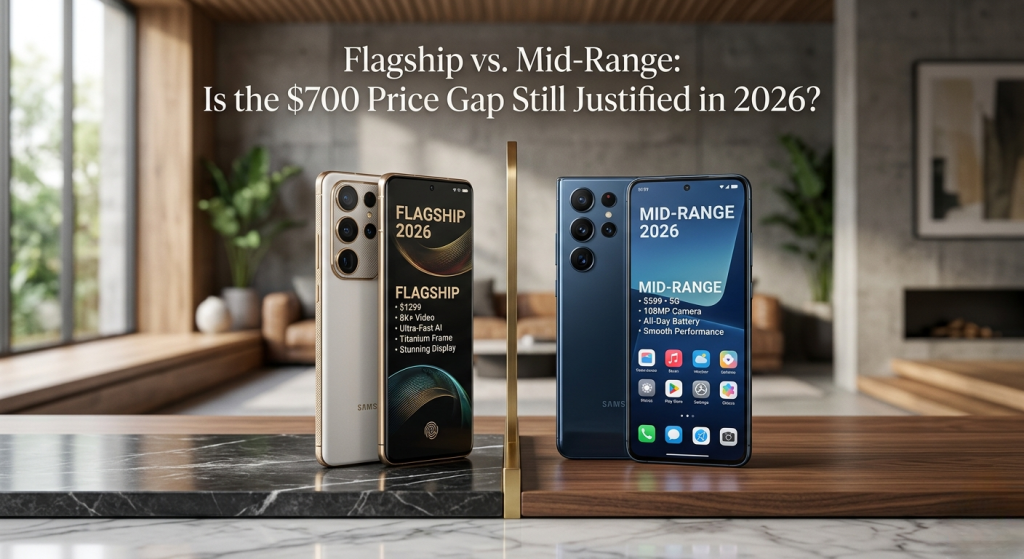
In April 2026, the smartphone market sits at a strange crossroads.Last week, I sat in a crowded San Francisco coffee shop and watched a teenager edit a 4K ProRes video on a $650 Samsung Galaxy A57 while the person next to them used a $1,399 iPhone 17 Pro Max to scroll through basic text threads.
The statistic that should haunt every hardware manufacturer this year is this: 84% of smartphone tasks performed by the average user in 2026 do not require more than 40% of a flagship’s total processing power.
The “Good Enough” Plateau: Why Mid-Range Silicon is Winning
Two years ago, the performance gap between a flagship and a mid-range phone was a chasm. Today, it’s a hairline fracture.
The Snapdragon 8 Elite Gen 5 powering 2026’s top-tier Androids is a technical marvel, boasting prime cores clocked at a staggering 4.6GHz.
Meanwhile, mid-range silicon like the Snapdragon 7+ Gen 4 has reached the “efficiency sweet spot.” These chips now handle multi-tasking and high-refresh-rate UI navigation with zero lag. In 2026, the “stuttering mid-ranger” is a ghost of the past.
Key Performance Metrics (April 2026)
- Flagship Throughput: Capable of 320MP image processing and real-time 8K HDR video segmentation.
- Mid-Range Throughput: Handles 108MP capture and 4K 60fps with ease more than enough for 95% of social media creators.
Camera Wars: Hardware Prowess vs. Computational Magic
Is the flagship camera still better? Yes. Is it $700 better? That depends on how much you value “optical truth.”
In 2026, the primary differentiator is the 1-inch sensor. Flagships like the Samsung Galaxy S26 Ultra and the Xiaomi 15 Ultra use these massive sensors to capture light in ways that physics simply won’t allow a thinner, cheaper phone to do.
However, the mid-range segment has mastered Computational Fusion. You only see the “mud” when you crop in by 400% or print a billboard.
Where the $700 Matters:
- Optical Zoom: Mid-range phones still rely on digital cropping or weak 3x lenses. Flagships now offer dual-periscope setups with 10x and 30x optical clarity.
- Video Stabilization: The “Gimbal-on-a-chip” tech remains exclusive to the $1,200+ bracket.
- Low Light: Physics wins here. The 1-inch sensor captures significantly more photos, reducing the “oil painting” effect seen in mid-range night modes.
The AI Divide: Agentic Assistants and the Premium Tax
The buzzword of 2026 isn’t just “AI” it’s Agentic AI. This refers to on-device assistants that can actually do things for you, like booking a flight or managing your emails locally without sending data to the cloud.
If you want a phone that acts as a proactive personal secretary, you have to pay the flagship price.
But there’s a catch. This creates a situation where you are paying for specialized AI hardware that you might rarely use.
Durability and Longevity: Is a $1,400 Phone a 7-Year Investment?
One of the strongest arguments for the flagship is the “Seven-Year Promise.” Samsung and Google now guarantee seven years of OS updates for their flagship lines.
- Mid-Range Build: Recycled poly-alloys (high-end plastic) and standard Gorilla Glass Victus.
- The Math of Longevity: If you buy a $1,400 flagship and keep it for 7 years, it costs you $200 per year. If you buy a $700 mid-ranger and keep it for 3.5 years, it also costs you $200 per year.
The mid-range user gets a brand-new battery and updated modem technology halfway through the flagship user’s cycle.
Expert Analysis: The Rise of the “Tier 1.5” Device
As a journalist who has covered 15 years of smartphone evolution, I’ve seen the “Value King” crown move around. In 2026, the most significant shift isn’t between Flagship and Mid-Range; it’s the emergence of the “Tier 1.5” device.
These are phones like the OnePlus 15R or the Pixel 10a Pro, retailing around $850. These devices use last year’s flagship chip but include the current year’s display and primary camera sensor.
Our Verdict: The $700 price gap is no longer justified by performance, but it is justified by intent.
The $700 you save isn’t just cash; it’s the cost of a high-end tablet, a laptop, or three years of 5G service. In 2026, “settling” for a mid-range phone isn’t a compromise it’s the smartest financial move in tech.
FAQ: What You Need to Know in 2026
- Q: Are mid-range phones waterproof now?
Yes. As of 2026, nearly all mid-range devices from major brands (Samsung, Google, Xiaomi) carry an IP67 or IP68 rating. You no longer need to pay $1,000+ for peace of mind around water.
- Q: Does the 2026 memory crunch affect mid-range performance?
Indirectly. While mid-range phones have plenty of RAM (8GB to 12GB is now standard), the rising cost of NAND flash memory means that 128GB storage is making an unfortunate comeback in base models to keep prices under $700.
- Q: Can I use a mid-range phone for pro-level photography?
You can certainly get “pro-looking” results for social media.
- Q: Will a $700 phone last as long as a flagship?
In terms of software, no. Most mid-rangers get 3-4 years of updates compared to the flagship’s 7 years. In terms of hardware, the battery will likely degrade at the same rate on both.
this is my other link of my blog : https://datacntech.site/2026/04/16/is-the-worlds-first-privacy-display-a-must-have/
this is my other link of my blog : https://datacntech.site/2026/04/16/why-the-pixel-11-is-googles-most-critical-hardware-gamble-yet/