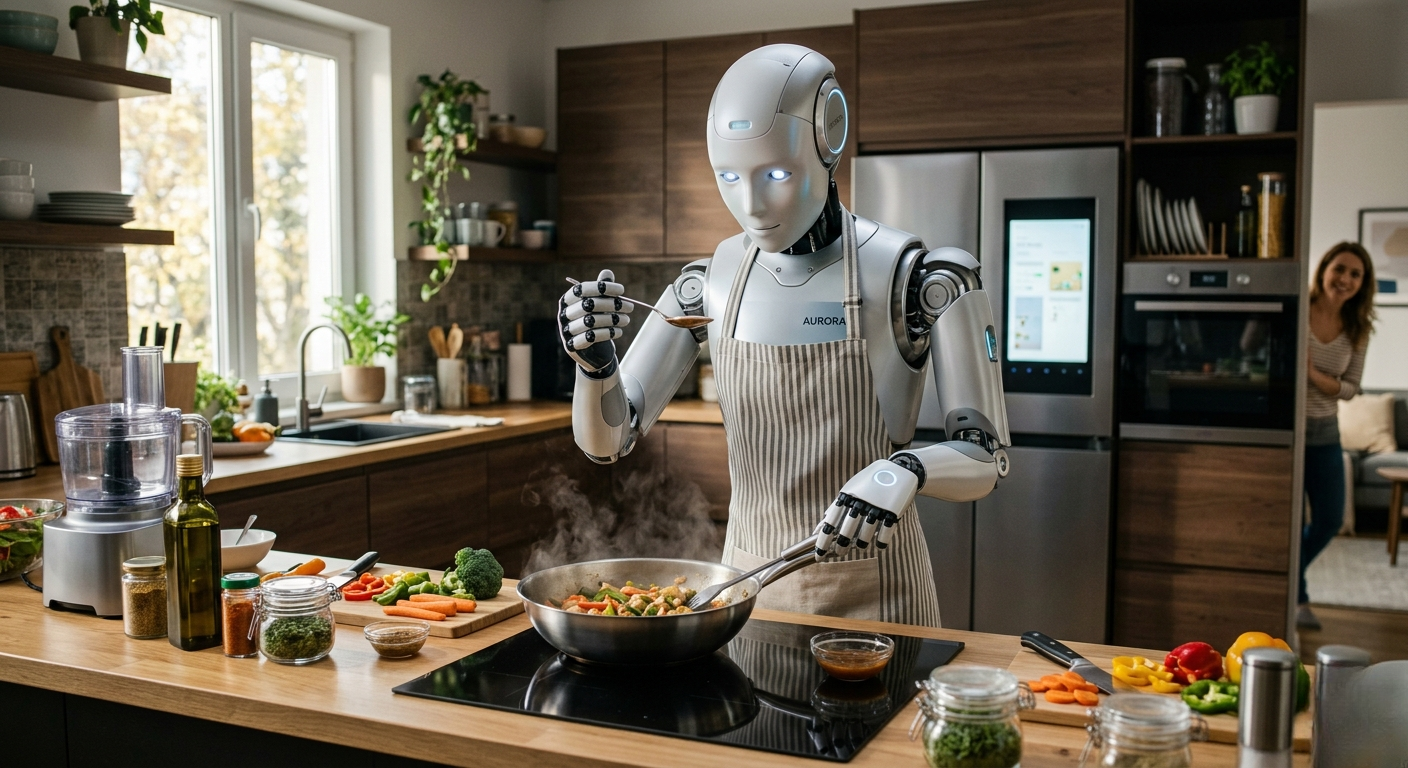
Fast forward to April 2026, and the landscape has shifted with startling speed.
The leap from $11.35 billion to $13.67 billion is a massive gain of over $2 billion in a single year. Yet, for the average homeowner, the sticker shock remains. With prices ranging from the cost of a used sedan to a luxury SUV, the “hype” is expensive.
You need to know what happens when the battery hits 5% and the robot is halfway up your stairs.
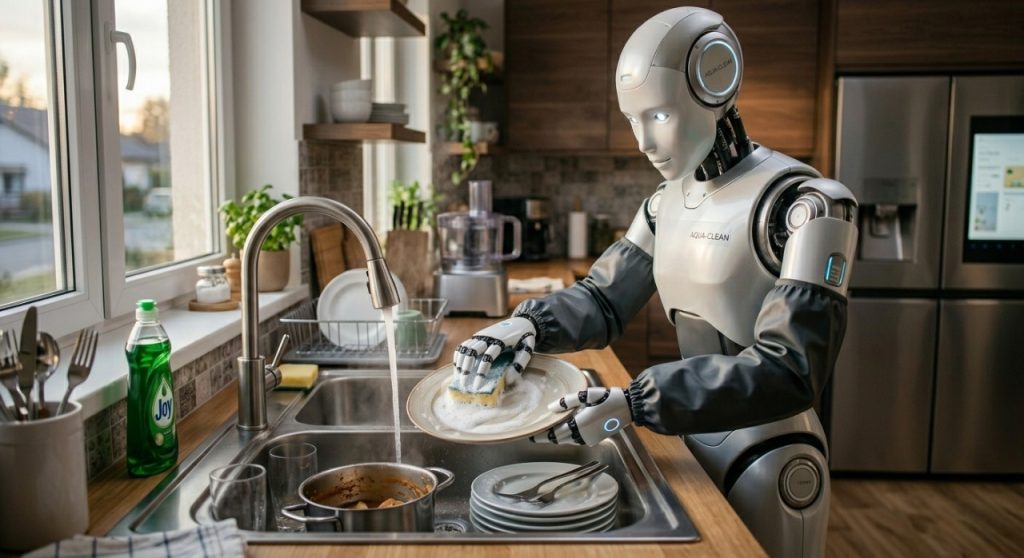
Can These Robots Actually Do the Laundry and Dishes?
The short answer: Yes, but with a significant “it depends.”
In early 2026, the breakthrough wasn’t in the hardware it was in the Vision-Language-Action (VLA) models. Unlike the rigid programming of the past, robots like the 1X NEO and the Figure 03 now use “Zero-Shot” learning. This means they don’t need to be programmed for every specific glass or plate in your cupboard. They recognize the “concept” of a dish.
- The Laundry Loop: Most 2026 models can now pull clothes from a dryer, identify a shirt from a pair of socks, and perform a basic fold. However, the “Information Gain” here is the failure rate. While the Figure 03 boasts a 92% success rate in towel folding, it drops to 65% for fitted sheets a task that still humbles most humans. make it simpler in one sentence
- The Dishwasher Dilemma: This is where dexterity meets disaster. Robots with “Parallel Grippers” (like the base Unitree G1) often struggle with curved surfaces like cereal bowls. You really need a “Dexterous Hand” model with at least 7 degrees of freedom (DoF) per hand to safely load a dishwasher without a 5% breakage rate.
Are They Safe Around Pets and Children?
Safety in 2026 has moved from “collision avoidance” to “force sensitivity.”
The Figure 03 introduced a proprietary tactile sensor capable of detecting forces as small as 3 grams roughly the weight of a paperclip. This is a massive leap forward. If a child’s hand is in the way of a closing cabinet, the robot doesn’t just stop; it feels the resistance before it becomes a pinch.
However, the “bipedal” nature of these robots introduces a new risk: The Tip-Over. A 35kg to 60kg robot falling over can cause serious damage. The Tesla Optimus V3 has industry-leading balance. However, a playful Golden Retriever can still knock it over. It just takes a hit at the right angle to trip it up.
Total Cost of Ownership: Beyond the Sticker Price
One of the biggest misconceptions in the 2026 market is that the purchase price is the final price. Much like the early days of electric vehicles, the “hidden” costs can be a shock.
1. Battery Degradation
These robots are power-hungry. Powering all those motors and sensors creates a lot of heat and drains the battery quickly. Whether it uses a custom chip or NVIDIA hardware, the high energy demand is a constant challenge. Expect to replace the main battery pack every 2–3 years at a cost of roughly $1,500–$2,500.
2. Maintenance of Moving Parts
The Tesla Optimus V3 uses a “tendon-driven” hand architecture. While this allows for incredible dexterity, cables stretch over time.
Expert Analysis: The “Dumb Dexterity” Paradox
We currently have “God-tier” AI brains paired with “Average-tier” hardware, creating a massive performance gap . This means a robot might be smart enough to predict exactly how a glass will fall, yet its physical parts are too slow to react. Ultimately, we are building genius minds trapped in clumsy bodies that cannot keep up with their own thoughts.
Our Verdict: If you are buying a robot in April 2026 for utility, look at the Unitree G1 EDU. Its hot-swap battery system is a game-changer for people who actually want the robot to work for more than two hours. If you are buying for safety and integration (especially if you have kids), the 1X NEO with its soft-to-the-touch exterior is the only logical choice.
Will My Floor Plan Even Work?
Bipedal robots are designed for a “human-built world,” but our homes are often more chaotic than a lab.
- Thresholds and Rugs: Most models handle 1-inch thresholds easily. However, thick “shag” carpeting or loose rugs are still a nightmare for bipedal balance.
If you want your robot to bring a heavy laundry basket from the basement to the second floor, you are pushing the limits of current bipedal stability.
- Charging Stations: You need about 4 square feet of dedicated space for a charging dock. Unlike a Roomba that can hide under a sofa, a 5-foot-tall robot needs a “home base” that is accessible and clear of clutter.
Frequently Asked Questions (FAQ)
- Q: Can I leave the robot alone with my kids?
No, Even with the best safety sensors, these are heavy machines. Current industry standards recommend “supervised autonomy” when children under 12 are present.
- Q: Does it record everything I say and do?
This depends on the privacy settings. Most 2026 models analyze your video locally on your device to keep your data private. However, they may still send small snippets or metadata to the cloud for training unless you manually turn that feature off.
- Q: What happens if it breaks? Can I fix it myself?
Stick with certified pros for Figure or Tesla repairs to avoid voiding your warranty or breaking the sensors.
- Q: How fast can they walk?
Most are capped at a “brisk human walk” of about 3–5 miles per hour for home use. They aren’t going to win a sprint, but they won’t feel sluggish moving between rooms.
Final Thoughts for the 2026 Buyer
The “Goldilocks” era of household robotics has arrived. We have moved past the toy phase, but we aren’t yet at the “Iron Man Jarvis” phase. If you have $20,000 to spend and a home with minimal clutter, these robots can legitimately save you 5–10 hours of chores a week.
this is link for more of my blogs : https://datacntech.site/2026/04/16/flagship-vs-mid-range-is-the-700-price-gap-still-justified-in-2026/
this is link for more of my blogs : https://datacntech.site/2026/04/16/is-the-worlds-first-privacy-display-a-must-have/
this is link for more of my blogs : https://datacntech.site/2026/04/16/why-the-pixel-11-is-googles-most-critical-hardware-gamble-yet/
robot is the future